Does Playing FPS Games Improve Reaction Time? What Transfers
A practical, evidence-aware guide for players who want faster reactions without confusing game practice, BallSheet drills, and controlled reaction tests.

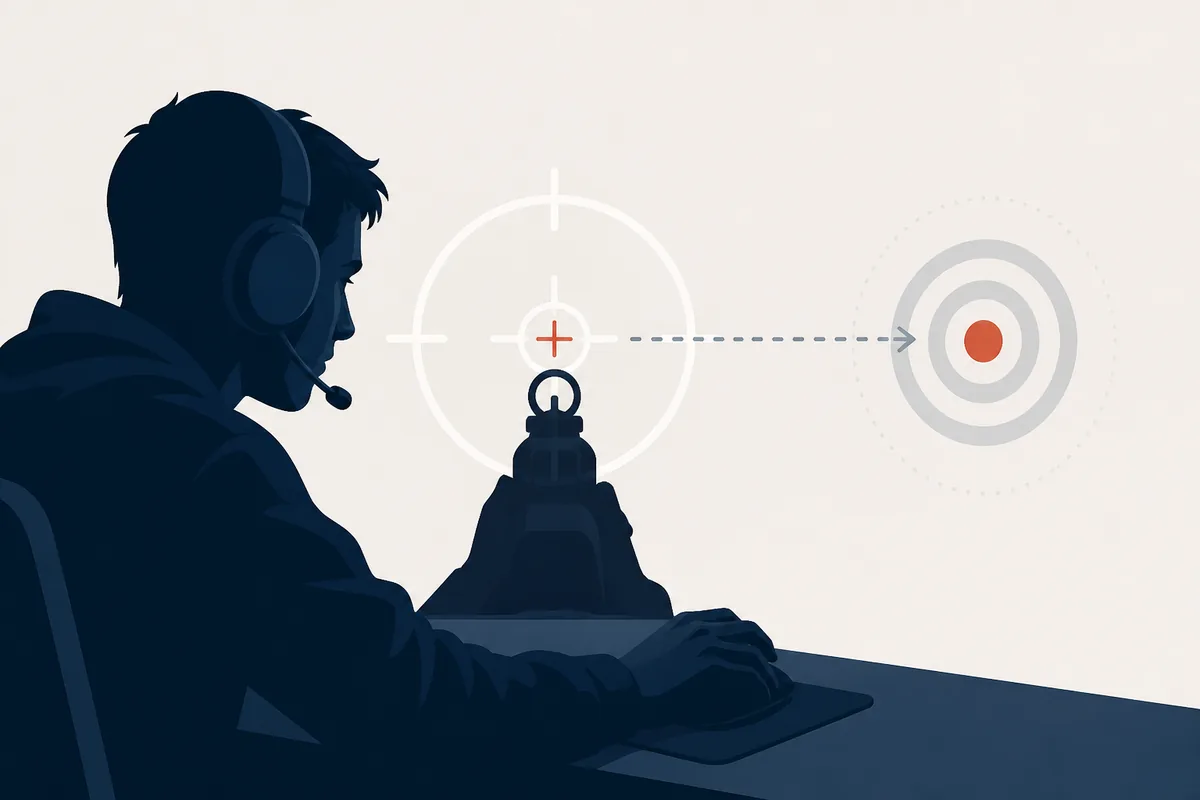
Editorial illustration, not a real game screenshot: FPS play can train visual decisions and target response, but the transfer claim needs careful boundaries.
Quick Answer
Playing FPS games can help some reaction-related skills, especially visual attention, target recognition, decision speed, and repeated hand movement in game-like contexts. The safer answer is not “FPS games permanently make every reflex faster.” Treat FPS play and BallSheet reaction training as practice environments, then use controlled reaction tests only as separate benchmarks.
Contents
What FPS Practice May Improve
FPS games ask you to read a visual cue, decide whether it matters, move toward a target, and correct your aim under time pressure. Repeating that loop can make players faster at the specific pattern they practice: scanning, recognizing threats, starting a movement, and recovering after a missed route.
That is why research and player experience often point in the same direction without saying exactly the same thing. Action-game practice is associated with improvements in visual attention and decision tasks, while everyday players notice that they react faster inside familiar game situations. Those are useful gains, but they are still context-shaped.
For BallSheet players, the closest transfer is target switching. You are not firing a weapon, but you are reading a new target, moving cleanly, and keeping calm as pressure rises. That makes BallSheet a good support drill for cursor path, recognition rhythm, and short-session discipline.
What Does Not Automatically Transfer
A faster in-game response does not automatically prove that every real-world reflex is faster. The task matters. A simple reaction-time test measures a narrow response to one stimulus. FPS play adds map knowledge, anticipation, crosshair placement, audio cues, movement prediction, and device latency.
This is the main reason to keep claims conservative. A player can become excellent at one game while still seeing ordinary results on a simple web reaction test. The opposite can also happen: someone can click quickly in a test but make poor decisions in a match because they react to the wrong cue.
Do not use FPS improvement to make medical, safety, driving, or workplace claims. It is better to say that game practice may improve game-like visual decision habits, while controlled tests are needed when you want a cleaner measurement.
| Area | What can improve | What to avoid | Best comparison |
|---|---|---|---|
| FPS match playgame context | Threat recognition, anticipation, crosshair readiness | Calling it a universal reflex score | Same game, same setup |
| BallSheet drillbrowser target switching | Cursor path, recognition rhythm, pressure recovery | Comparing with OGL or another trainer directly | Same browser and device |
| Reaction testcontrolled stimulus | Simple click response under narrow conditions | Treating it as full game skill | Same test and environment |
A BallSheet-Style Practice Routine for FPS Players
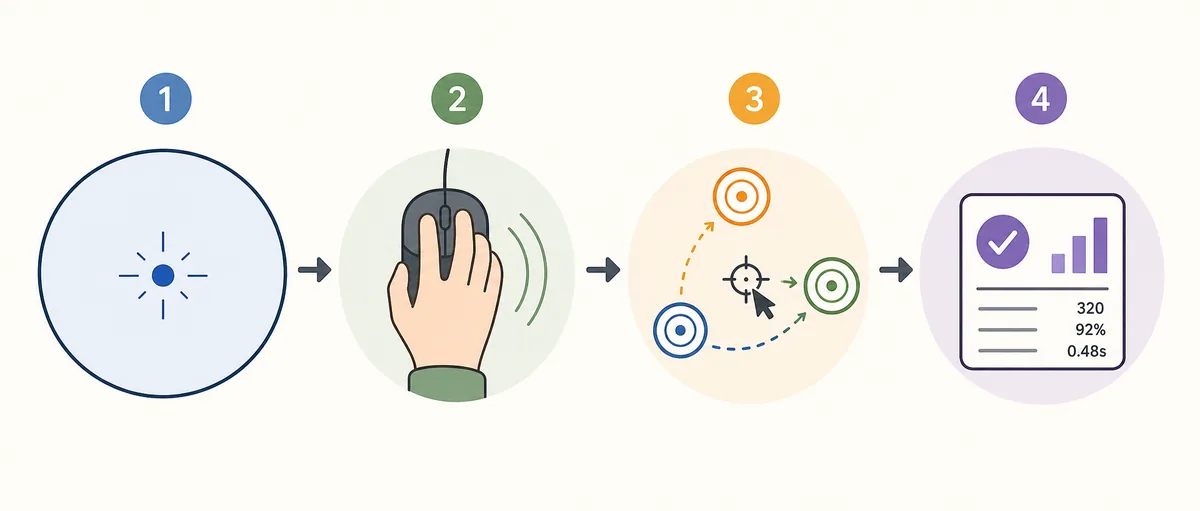
Use BallSheet as a short support drill before or after FPS practice. Start with two relaxed runs to warm up the mouse hand. Then play five focused runs with one goal: shorter cursor paths, calmer recovery after overshoot, or faster recognition of the next target.
Do not change sensitivity, browser zoom, fullscreen state, or device in the middle of the set. A useful session needs stable conditions. If every run uses a different setup, you cannot tell whether the improvement came from practice or from the environment.
After the set, write down one metric only. Average reaction, balls per second, and survival time answer different questions. The cleanest habit is to track one stat for several sessions before deciding whether your reaction rhythm is actually improving.
Simple session rule
Warm up, choose one focus, play a short fixed set, record one stat, and stop before fatigue makes the feedback messy.
What Is a Good Reaction Time for FPS Games?
There is no single good FPS reaction time because the game situation matters. A clean pre-aimed shot, a surprise target, a wide flick, and a movement read all require different decisions. The number from a reaction-time website is only one part of the picture.
For players, consistency is usually more useful than one peak. If you can repeatedly recognize targets, begin movement smoothly, and avoid late panic corrections, your practical game reaction is improving even if a simple click-test number moves slowly.
If you want a separate benchmark, use a stable reaction-time test such as Human Benchmark and record the same environment each time. Then keep that result separate from BallSheet scores and FPS match notes.
| Benchmark | Measures | Does not measure | Use it for |
|---|---|---|---|
| Simple reaction testone stimulus | Click response under narrow conditions | Game sense, aim path, pressure recovery | Baseline only |
| FPS practicematch decisions | Recognition plus movement and timing | Isolated reflex alone | Game-specific improvement |
| BallSheet settarget drill | Cursor path and short reaction rhythm | Weapon mechanics or recoil | Warm-up and review |
Practice vs Controlled Testing
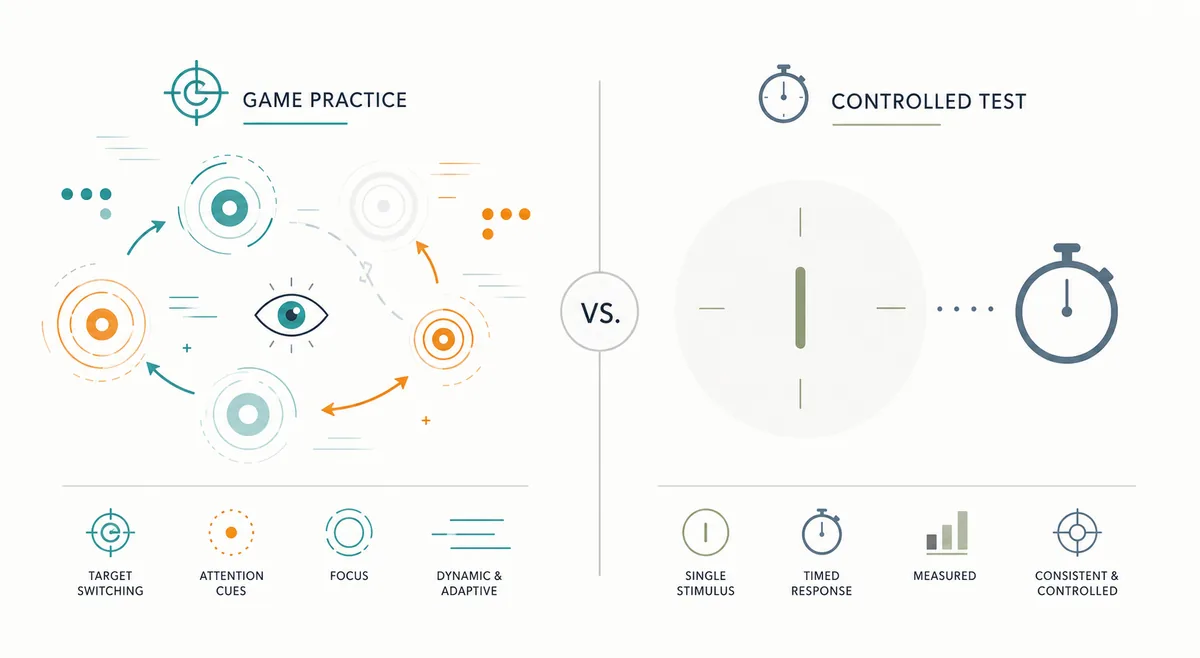
The most useful way to think about this topic is to separate practice from proof. FPS and BallSheet sessions are practice: they build habits in a dynamic environment. A controlled test is measurement: it removes many variables so one response can be compared more cleanly.
Both are useful, but they should not be merged into one leaderboard. Browser focus, monitor refresh, mouse latency, fatigue, caffeine, posture, and noise can all change a result. If the conditions change, write them down or ignore the comparison.
For SEO searchers asking whether FPS games improve reaction time, the best practical answer is conditional: they can help with game-like reaction skills when the practice is focused, repeated, and reviewed, but they are not a magic upgrade for every real-world reflex.
Common Mistakes When Training Reaction Time With Games
The first mistake is grinding while tired. Reaction practice becomes less useful when your hand is tense and your attention is gone. Short, repeatable sessions usually beat long unfocused ones.
The second mistake is changing too many variables. If you switch games, sensitivity, browser zoom, display mode, and input device in one session, your scores stop being useful evidence.
The third mistake is chasing a single lucky result. One great run can happen by chance. A cluster of cleaner runs across the same setup says much more about whether your reaction rhythm is improving.
FAQ
Sources and Related Practice Pages
Last updated: July 9, 2026
Play BallSheet Online